
Conservation Stories: Eliza Steele of Empyrean Farms

“Farming asks everything of you, and it's easy to let the bigger picture projects keep getting pushed to the back burner. What I want other farmers to hear is simple: you don't have to figure it all out alone, and you don't have to have deep pockets to do things right. Resources like the Whatcom Conservation District exist precisely for farms like ours — working farms trying to build something meaningful, care for their animals well, and leave the land better than they found it.” – Eliza Steele, co-owner and operator of Empyrean Farms
Dreaming of starting a farm is always easier than the realities of farming, but Eliza Steele and Jeremy Dehnert are making their dreams a reality, with some help from local partners. They are passionate about seeds and regenerative farming; Eliza attributes the start of this passion to a time she and Jeremy spent living and working on a friend’s farm on Vashon Island.
“[Growing my first garden] was one of those experiences that quietly rewires you — you show up thinking you're just growing some vegetables, and you leave understanding something much deeper about how food, land, and community are connected. While I was there, the farm — Wild Dreams Farm and Seed — was in the process of building out a seed business, and watching that unfold up close was genuinely formative. Seeing how intentional seed saving and production could serve not just one farm but an entire region planted a seed of its own in me, if you'll forgive the pun. It gave me a living, breathing model for what a small farm could grow into when it was rooted in something bigger than just yield. That experience is a direct thread to what we're building at Empyrean today — our own push into open-pollinated, bioregional seed production feels like a continuation of something that started for me on Vashon Island.”

Eliza and Jeremy bought the land that Empyrean Farm is on in 2020. They initially looked at the property because of its proximity to Mt. Baker, but as soon as Eliza stood on the land, she could visualize their future farm. However, there would be a lot of work to get there. Luckily, Eliza and Jeremy developed a network of support and resources to reach their goals.
“When we first walked this property, we could already see what it could become. That vision has driven everything we've done here, and partnering with the Whatcom Conservation District has been a huge part of turning that vision into reality.”
Empyrean Farm has a beautiful historic barn, as well as 14 acres of fields that border Kendall Creek. The barn and surrounding heavy use (confinement) area have ample space for their cows, horses, sheep, and chickens. However, water had become a major issue for the barn during the winter. Water from the roof of the barn would pool in the heavy use area, impacting the barn foundation, animals, and Eliza’s daily life. “Mud sounds like a minor inconvenience until you've spent a Pacific Northwest winter managing livestock in it — then it becomes one of the most demoralizing parts of the job.”

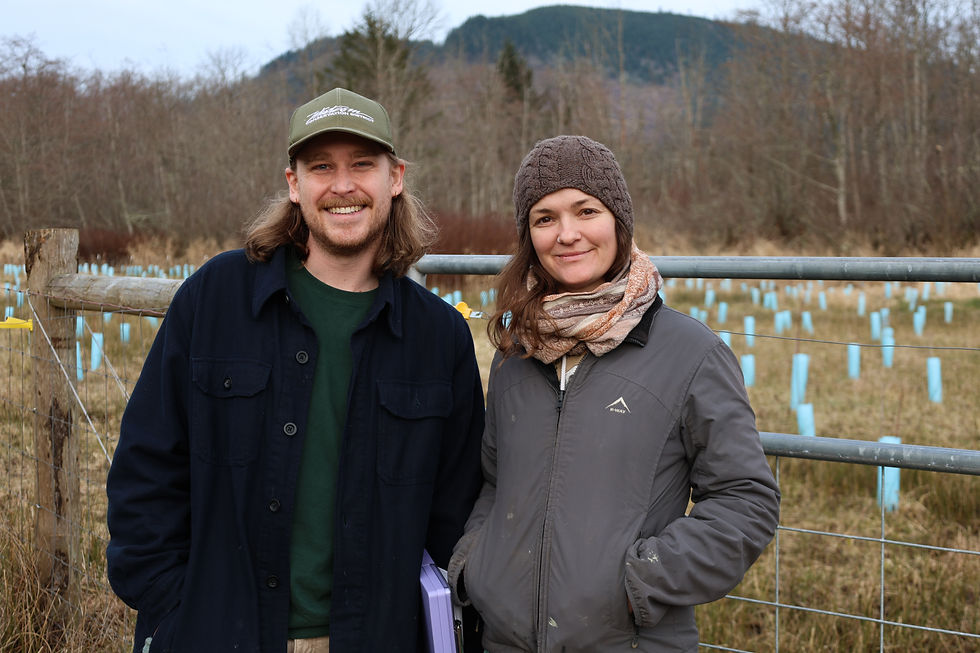
Eliza had heard about free farm planning from Whatcom CD and decided to reach out. She walked her property with a farm planner and a habitat specialist. They talked about her goals for her business and property, the current challenges she was struggling with, and resources she could use. From that conversation, two collaborative projects came to fruition: upgrading their heavy use area and planting a riparian buffer along the creek.
“Working with the Whatcom Conservation District has been one of the most genuinely collaborative relationships I've built since starting this farm. They haven't just helped me check boxes on infrastructure projects — they've been real partners in thinking through what's possible here and how to do it in a way that aligns with the values we farm by.”
This included a grant through Whatcom CD to improve their heavy use area. Jeremy and Eliza received the grant in 2024 and went to work. They installed gutters on their barn redirecting the water and upgraded their footing for better drainage.

“Before the upgrades, every trip out to the confinement area during the rainy season meant slogging through it, the animals were standing in it, and it just ground you down after a while. Now, the footing is solid and the gutters are doing their job — stormwater moves away from the barn the way it should, instead of pooling around the foundation and turning everything into a mess. My daily chores are genuinely easier and faster. I'm not fighting the mud anymore, I'm just doing the work.
The difference in my animals has been just as noticeable. Their feet are in markedly better condition, which matters enormously for their comfort and long-term health. There's something about seeing your animals standing on clean, dry ground that just feels right — it lifts the whole energy of the place.
And honestly, knowing that the water is now flowing away from the barn's foundation instead of saturating it gives me real peace of mind about the long-term integrity of the structure. We've put a lot of love and intention into this farm, and protecting that investment — practically and emotionally — matters to me. It's one of those projects where every single day I notice it, and every single day I'm glad we did it.”

Another major obstacle Eliza and Jeremy had to navigate was their proximity to Kendall creek, a fish-bearing tributary of the Nooksack River. Every winter heavy rains cause the creek to rise, flooding large portions of their fields. Luckily, Whatcom CD has funding to help establish riparian buffers that can reduce the impacts of flooding. The native plants can help slow the spread of the water and improve absorption. The funding also covered new fencing further from the creek for their livestock and hydroscaping to guide where the water would flow. But Eliza had a vision beyond flood mitigation.

“This project has always felt like one of the most visionary things we've taken on at Empyrean — because so much of its value lives in the future, and you have to be willing to plant for a farm you haven't fully grown into yet. The benefits we were chasing from the start were layered. First and most practically, the creek that runs through our property has a history of flooding, and establishing deep-rooted vegetation along those banks is one of the most effective tools we have for slowing, spreading, and absorbing that water before it becomes a problem. But what really excites me about how we've approached this buffer is that we pushed past the conventional model. Rather than planting it purely as a conservation corridor and walking away, we've been working with the Whatcom Conservation District to design it as a working buffer — one that will eventually yield edible and harvestable crops. Fruit trees, berry bushes, and other useful plants that can thrive in a riparian environment and give something back to the farm while doing their ecological work. That intersection of productivity and conservation is deeply aligned with how I think about this land overall. What I'm most excited for, once everything matures, is having a genuinely productive edge on the farm that most people wouldn't even recognize as a conservation project. A living, harvestable buffer that protects the creek, feeds pollinators, stabilizes the floodplain, and produces food — all at the same time. That's the vision. And I think we're going to get there. “
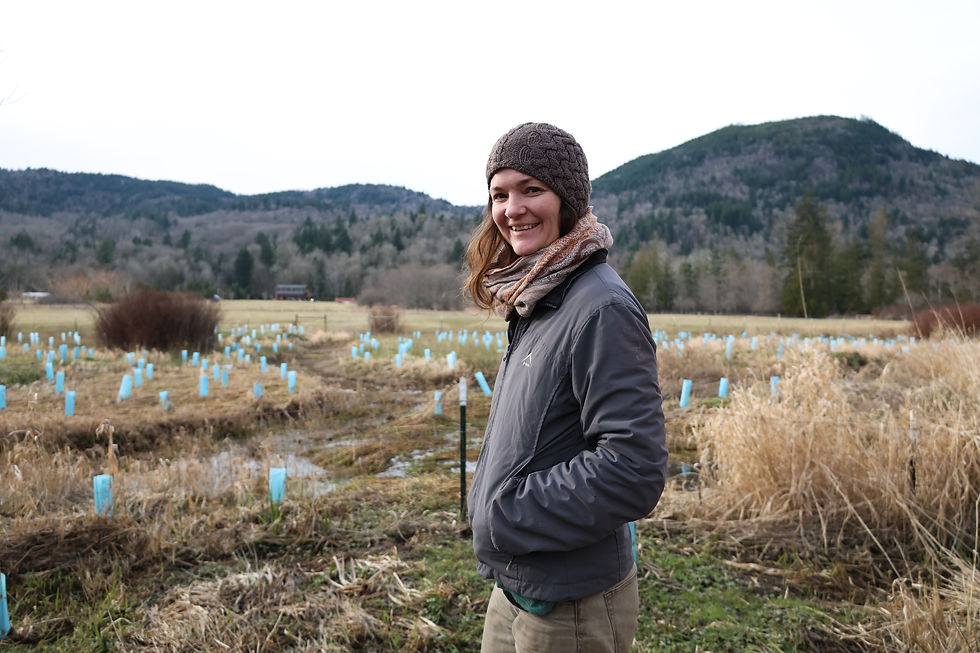
Today, Eliza describes Empyrean Farm as “a small, diversified farm rooted in agroecological land stewardship, preserving biodiversity and seed sovereignty. Production centers on open-pollinated seed crops, fresh produce and a small herd managed through rotational grazing. Manure from livestock is composted on-site and returned to fields; building soil fertility and creating a closed-loop system that minimizes outside inputs. The farm operates on solar-generated electricity reflecting regenerative values. A farm stand provides direct access to local food and supports neighboring producers.” She is excited to continue to nurture the property, grow her business, and continue to foster community. She recently received a grant to restore the historical barn and has created a partnership with the Foothills Food Bank. She urges all farmers with a dream for their property to reach out and ask for help, including from Whatcom CD.
“I think there's a tendency to assume that working with any kind of government-adjacent organization is going to mean red tape, bureaucracy, and someone telling you what you can and can't do on your own land. That has not been my experience with Whatcom CD at all.
What I found was a team of people who are genuinely knowledgeable, easy to talk to, and invested in finding solutions that actually work for your specific operation. They're not coming in with a one-size-fits-all agenda — they show up, they look at your land, they listen to what you're trying to do, and they help you figure out how to get there. The cost-share funding is a real bonus, but honestly the partnership itself has been just as valuable.
I've already seen several of my neighboring farms reach out and start their own projects after hearing about my experience, and every single one of them has said some version of ‘I wish I'd done this sooner.’ That's pretty telling.
You don't have to have everything figured out before you make that first call. You just have to be willing to start the conversation. The worst thing that happens is you learn something — and in my experience, you'll come away with a whole lot more than that.”
Eliza and Jeremy are hosting an open house with us showcasing their new buffer. If you would like to see a year-old riparian buffer in action on a working farm, join us April 23rd for our Working Lands, Healthy Streams Open House. You can learn more about Empyrean Farm and upcoming farm events at their website. If you have goals for your farm that you are looking for help and resources with, schedule a free and confidential site visit with Whatcom CD today!


Comments